
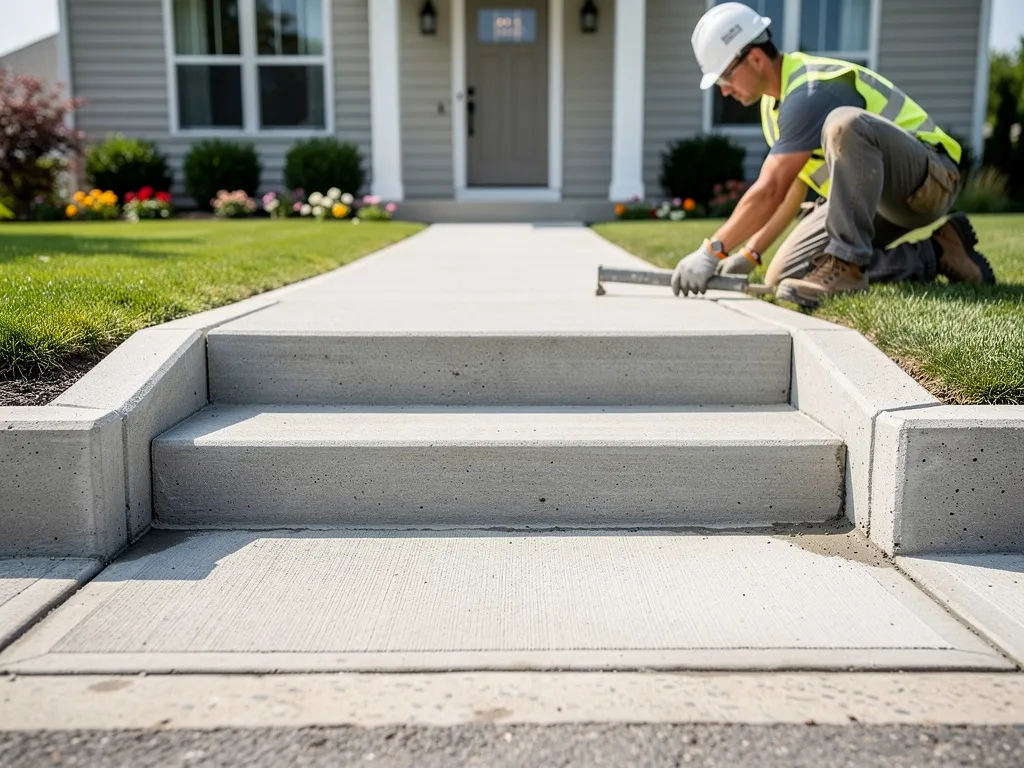
“Concrete always cracks” is the most common thing we hear from homeowners in Pearland — usually right after they show us a driveway or patio that failed in three or four years. It’s a half-truth. Concrete does crack eventually; that’s the nature of a rigid material. But the dramatic, ruin-the-slab cracking people fear is almost always preventable, and in Pearland it comes down to two local culprits, only one of which is the heat.
The Real Cause #1: Pearland’s Expansive Clay Soil
This is the big one, and it’s not heat-related at all. Most of Pearland and Brazoria County sits on expansive clay — soil that swells when it absorbs water and shrinks as it dries. Over a year, that soil lifts and drops your slab in different spots by fractions of an inch. A slab that isn’t reinforced and isn’t sitting on a proper base gets bent by that movement until it cracks.
How a good pour fights it:
- A compacted granular base breaks the direct contact between the wet clay and the concrete and creates a layer that evens out minor movement.
- Reinforcement (rebar or wire mesh) sized to the slab lets the concrete span small soft spots instead of cracking over them.
- Proper slope and drainage keeps water from pooling against and soaking the subgrade in the first place — the less the clay cycles wet-dry, the less it moves.
Skip the base, undersize the reinforcement, and ignore drainage, and a Pearland driveway will crack no matter how good the concrete itself is.
The Real Cause #2: Heat and Fast Drying
Here’s where the Texas heat actually does damage — not by cracking finished concrete, but by ruining the pour before it ever cures. Concrete doesn’t “dry”; it cures through a chemical reaction that needs water. On a 100-degree Pearland afternoon, the surface water evaporates faster than the reaction can use it, and the slab:
- Shrinks rapidly at the surface (plastic shrinkage cracking — those fine, random surface cracks).
- Loses strength because the hydration reaction stalls from lack of moisture.
- Sets too fast to be properly finished and jointed.
We counter this by:
- Pouring early in the day or in cooler windows so the slab isn’t fighting peak heat.
- Using evaporation retarders and fogging/misting the surface to slow moisture loss.
- Curing the slab — keeping it damp (curing compound, wet burlap, or ponding) for the critical first several days so it gains full strength instead of baking dry.
The single biggest heat-related mistake we see from low-bid pours is no curing step — the crew finishes and walks away, the sun bakes the surface, and the slab is weak and micro-cracked from day one.
The Preventable Cause #3: Missing or Bad Joint Layout
Concrete wants to crack; the job is to make it crack where you want. Control joints are deliberate grooves cut (tooled or sawn) into the slab at a planned spacing so that when the concrete shrinks as it cures, it cracks along the weak line you made — not in a random zigzag across your driveway.
A real joint plan accounts for:
- Spacing — joints roughly 2–3 times the slab thickness in feet (a 4-inch slab → joints every 8–12 feet), never spanning too far.
- Geometry — joints at re-entrant corners and changes in slab shape, where stress concentrates.
- Timing — saw cuts made within the first hours after set, before shrinkage cracking beats you to it.
An eyeballed joint layout, or joints spaced too wide, is why you see driveways with a crack running diagonally across the field instead of down a neat joint line.
The Preventable Cause #4: A Weak or Too-Thin Mix
A 3,000 PSI mix poured 3 inches thick over no base will crack under daily passenger traffic on Pearland clay. We pour driveways at a minimum 4 inches with a 4,000 PSI mix as the floor (heavier for truck/RV loads), and we don’t go thinner to win a bid. Thickness and mix strength are cheap relative to a teardown.
How to Tell Whether a Crack Is a Problem
Not every crack means the slab is failing:
- Hairline cracks within joint panels — usually cosmetic, from normal shrinkage. Monitor; rarely structural.
- A crack running cleanly down a control joint — that’s the joint doing its job. Not a defect.
- Wide, uneven, or “heaved” cracks with one side higher than the other — that’s soil movement underneath, and it’s the one to take seriously. It points to base or drainage failure that will keep progressing.
If you’re seeing the third kind, that’s a concrete repair conversation, not a cosmetic one.
The Short Version
Concrete cracks in the Texas heat mostly because of what’s underneath it and how it was cured — not because concrete can’t handle hot weather. A slab built with a real base, sized reinforcement, a proper joint plan, a 4,000+ PSI mix, and an actual curing step will shrug off Pearland’s clay and heat for decades. The shortcuts that cause early cracking are all choices, and they’re all avoidable.
If your driveway or patio is cracking — or you want the next one poured so it won’t — call us at (832) 225-3830 or request a free estimate.