
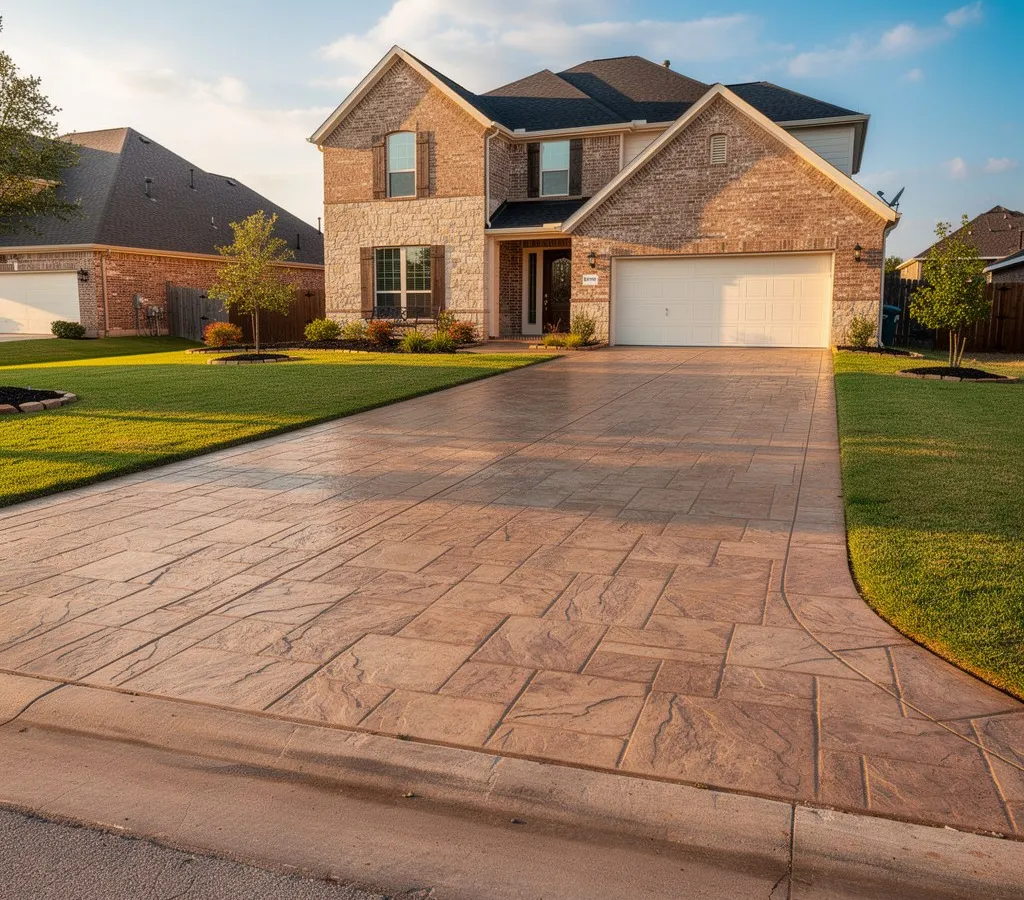
Homeowners in Pearland ask us this all the time: stamped concrete or pavers? Both can look high-end, both come in a wide range of colors and patterns, and both cost more than a plain broom finish. The honest answer is that either one can last 25+ years if it’s installed right for our soil — and both will fail fast if they’re not.
The deciding factor in Pearland isn’t usually looks or even price. It’s how each material handles the expansive clay soil underneath, how it drains, and how it gets repaired when something eventually does move. Here’s the comparison we walk customers through.
Cost Comparison in Pearland
Rough 2026 installed pricing for a typical driveway or patio:
- Stamped concrete: $10–$16 per square foot
- Concrete pavers: $14–$22 per square foot (installed over a proper base)
- Standard broom-finish concrete: $6–$10 per square foot
Pavers carry a premium because each unit is set by hand, the base prep is more involved, and the edging restraints add labor. Stamped concrete is poured in one monolithic slab and then patterned while it’s still wet, which is more efficient — but it demands a skilled finisher, which is why the price climbs above a broom finish.
How Each Handles Pearland’s Clay Soil
This is the part national guides get wrong, because they’re written for stable sandy or loamy soil. Pearland and most of Brazoria County sit on expansive clay that swells when it’s wet and shrinks during our dry stretches. That movement is relentless and it affects the two materials very differently.
Stamped concrete is a single continuous slab. That’s a strength and a weakness. When the base is prepped and reinforced correctly — compacted granular base, rebar or mesh sized to the slab, control joints in a real layout — a monolithic slab spreads the soil’s movement across the whole pour and resists cracking for decades. Done wrong, with no base and thin reinforcement, the same soil movement cracks it into a puzzle.
Concrete pavers are flexible by design. Because each unit is a small individual piece set in sand or polymeric jointing, the surface can flex with minor ground movement without cracking. That sounds like an advantage on clay — and it is, for small movements. The trade-off is that pavers can settle, dip, and become uneven over time as the base shifts, and a settled paver path looks worse faster than a hairline crack in concrete. The base is everything: a paver install without a properly compacted base on Pearland clay will rut and dip within a couple of years.
Bottom line on soil: stamped concrete rewards a thorough base-and-reinforcement build (it’s rigid, so it either holds or cracks); pavers reward a thorough base build (it’s flexible, so it either stays flat or dips). Both require the same boring, non-negotiable subgrade work.
Drainage and Water
Pearland gets drenching Gulf storms, and how your surface handles water matters as much as how it handles soil.
- Concrete is sloped as a single sheet, so water sheets off cleanly toward a planned drainage path. No water gets through the surface.
- Pavers have joints, and even with polymeric sand, some water infiltrates into the base. On clay soil, that moisture is what drives the swelling-and-shrinking cycle underneath. Good paver installs include edge drains and a sloped, compacted base to move that water out — it’s doable, it’s just extra planning.
For a flat Pearland lot with heavy runoff, a well-sloped concrete slab is usually the lower-maintenance choice on water alone.
Repairs and Long-Term Maintenance
This is where the two genuinely diverge:
Stamped concrete: If a section cracks or stains, repair is harder. A crack can be filled and the pattern can be touched up, but a perfect color match after years of UV exposure is nearly impossible. A badly damaged section means cutting out and repouring. Maintenance is otherwise low — periodic cleaning and resealing every 2–4 years to keep the color vivid.
Pavers: The upside is modularity. A stained or cracked paver is popped out and replaced in minutes. A settled area can be lifted, re-leveled, and re-set without demolition. If you value the ability to fix problems surgically — or you plan to pull up a section later for plumbing — pavers win. Maintenance is joint-sand top-ups and occasional re-leveling of settled spots.
Looks and Resale
Both can look premium. Stamped concrete gives a seamless, custom look and can mimic stone, slate, or brick with integral color that resists fading. Pavers give authentic texture and crisp, repeating patterns that many buyers associate with higher-end installs. On resale in the Pearland market, either one outperforms a plain broom finish; the difference between the two is largely a matter of taste.
How to Choose for a Pearland Property
- Pick stamped concrete if you want a seamless custom look, lower installed cost, and a single sloped surface that sheds water — and you’re confident in the crew’s base and reinforcement work.
- Pick pavers if you want authentic texture, the ability to replace or lift individual units later, and you’re prepared to maintain joint sand and re-level occasional settled spots.
Both are good choices. The bad choice is either one installed over a skip-job base on Pearland clay — that’s the failure mode we see, and it’s avoidable.
Want a Comparison Quote for Your Driveway or Patio?
We install both stamped concrete and paver systems, and we’ll tell you honestly which fits your lot, your soil, and your budget — including where the base work has to go to keep either one from failing. You get a fixed, itemized price either way.
Call (832) 225-3830 or request a free estimate and we’ll walk the site with you.